When we talk about air conditioners and their external nuisances, I often hear people say that "they give off a little heat," as if that weren't a problem. However, according to some studies, it would seem that the heat emissions are actually relatively low.
A study published in 2020 estimates that air conditioning all of Paris during a heat wave would only increase the air temperature by +0.25 to +0.75 °C in the city center. This seems insignificant.
But this study relies on a modeling tool (the TEB model) that uses a very simplified geometry and assumes that the air in the street around buildings forms a homogeneous block. This model is useful for conducting a study on a metropolitan scale, but not for understanding what actually happens on a single street.
To study local heat transport on a street, it is necessary to use a computational fluid dynamics (CFD) tool and analyze the building height/street width ratio (H/W).
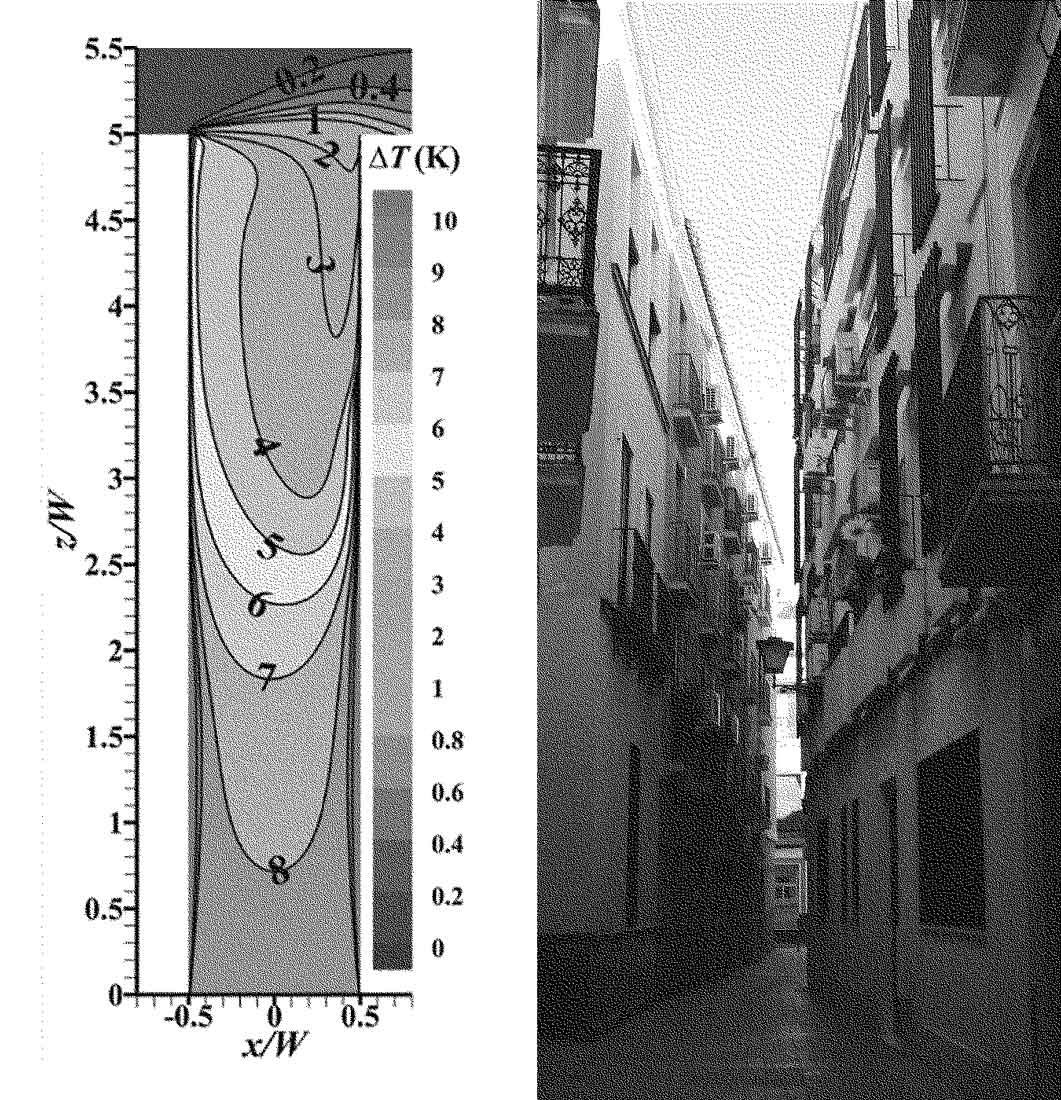
A study published in 2025 shows, for example, that on a very narrow street (H/W = 5), heat emissions from air conditioners can locally cause an increase in air temperature of 2 to 10 °C, depending on the wind.
Yes, you read that right: we're talking about +10 °C.
By calculating the average temperature of the air layer in which pedestrians walk (between 0 and 2 meters), the study estimates that they would be exposed to +8°C due to heat emissions in a very narrow street. This is absolutely enormous.
These results are significantly higher than the average values obtained by urban models used at the scale of an entire city and are far from the 0.75°C modeled by the TEB. They serve as a reminder that the impact of air conditioning on public spaces is highly dependent on the street's geometry at the microclimate level.
Of course, all of this is only valid when the outdoor units are oriented towards the street, as overheating becomes almost negligible (1°C) when they are installed on the roof. Air conditioning saves lives, but its development must not come at the expense of the quality and comfort of public spaces. Our historic European cities have streets that must retain their full value and utility for commerce, tourism, and the quality of life they offer. Do we want to sacrifice the quality of life in public spaces to preserve our housing?
Images:
- Left: Air temperature in a narrow street (H/L = 5) under the effect of facade air conditioning (Yujie Zhao et al., 2025)
- Right: Narrow street in an air-conditioned historic center
Sources:
- TEB Model (Vincent Viguié et al., 2020)
- CFD Model (Yujie Zhao et al., 2025)